-
Shop
- Advanced Technologies
- AI Career Advantage Collection
- AI Skills Mastery 2026 Collection
- Arts, Crafts & Hobbies
- Bathroom
- Best-Sellers
- Car Accessories
- Dating & Social Skills
- Denim
- 7FOR
- AGOLDE
- Antony Morato
- Armani Exchange
- Boss
- Brunello Cucinelli
- Calvin Klein Jeans
- Costume National
- Desigual
- Diesel
- Dolce & Gabbana
- Dsquared²
- Ermanno Scervino
- Fendi
- Gianni Lupo
- Guess Jeans
- Ichi
- Just Cavalli
- Lee
- Levi's
- Liu Jo
- Morgan De Toi
- Mother Denim
- Only
- Pepe Jeans
- Pinko
- Replay
- Valentino
- Vero Moda
- Digital Resources
- Education & Learning
- Family & Parenting
- Fashion
- Furniture
- Gadgets
- Health & Beauty
- Health & Wellness
- Home & Garden
- Kids & Babies
- Kitchen
- Lighting
- Patio, Lawn & Garden
- Personal Growth
- Pet Care
- Pet Supplies
- Pets
- Sport & Outdoors
- TikTok Growth & Monetization Mastery
- Travel
- Wealth
- Popular
- Best deals
Test-Drive Multiple Cars: Compare Fairly Before You Buy
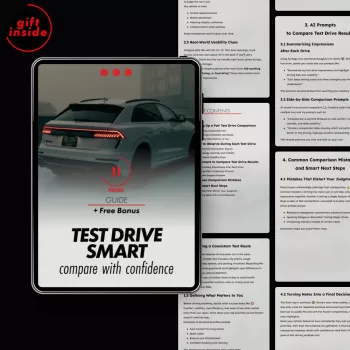
Test Drive Smart, Compare With Confidence: A Practical Guide to Driving and Comparing Multiple Cars Before You Buy
Test-driving more than one car only works if each drive is comparable. A consistent plan helps you capture the same observations every time—so you can turn “gut feel” into clear trade-offs on comfort, visibility, performance, tech, and total cost.
Set the goal: decide what “better” means for your daily driving
Before stepping onto a lot, define what success looks like for your real routine—not a fantasy weekend.
- List your top 5 use-cases (commute, school runs, road trips, snow, parking downtown) and rank them by frequency and importance.
- Choose 3 non-negotiables to keep decisions clean (examples: driver seat comfort, cargo space with stroller, AWD, top safety ratings, towing).
- Pick 3 nice-to-haves so you don’t “feature creep” into a trim you’ll regret paying for (examples: panoramic roof, premium audio, wireless CarPlay/Android Auto).
- Set budget boundaries: ideal purchase price range, monthly payment target, and an insurance comfort zone.
If safety is a core requirement, verify ratings through NHTSA’s 5-Star Safety Ratings and IIHS ratings before you fall in love with a specific model.
Before the dealership: build a fair comparison set
The easiest way to get confused is to compare mismatched trims. Keep your test-drive lineup as “apples to apples” as possible.
- Match key trim factors: engine, drivetrain, wheel size, and major option packages.
- Check specs that change the feel: wheelbase, curb weight, tire size, power/torque, and ground clearance.
- Shortlist 3–5 vehicles max for the same weekend so your impressions stay fresh.
- Bring the same passengers and gear to every drive—especially car seats, strollers, or a work bag that lives in the trunk.
Schedule smarter: control time, route, and conditions
Small changes in traffic, glare, or road surface can make one car seem better than it really is. Control what you can.
- Book appointments close together and request the exact trim in advance to avoid “this one is similar” substitutions.
- Drive the same route every time: neighborhood streets, a rougher road segment, and a highway merge.
- Test at similar times of day to keep traffic patterns and sun glare consistent.
- If weather shifts, prioritize the vehicles where traction, visibility, or ride comfort matters most.
Five-minute walkaround: quick checks that prevent surprises
Do this the moment you sit in each car. It’s fast, repeatable, and catches issues that don’t show up in a brochure.
- Visibility check: set the seat and mirrors; note blind spots, A-pillar thickness, and rear window shape.
- Entry/exit: test front and rear access, seat height, door opening width, and ease of loading car seats.
- Cargo reality: open the trunk/hatch; check loading height, usable depth, and how the rear seats fold.
- Tires and wheels: larger wheels can look great, but may ride harsher and cost more to replace.
- Controls and ergonomics: confirm you can reach HVAC, volume, and drive-mode controls without hunting through screens.
The drive: run the same “script” in every vehicle
Consistency makes your notes trustworthy. Use a simple driving script so every car gets the same chances to impress (or disappoint).
Test-Drive Comparison Scorecard (use the same scale each time)
| Category | What to check | Score (1–5) | Notes (be specific) |
|---|---|---|---|
| Driver comfort | Seat support, adjustability, thigh support, armrest placement | ||
| Visibility | Blind spots, mirror view, camera quality, pillar thickness | ||
| Ride quality | Bumps, vibration, body control, head toss in back seat | ||
| Cabin noise | Road noise, wind noise, engine noise at 70 mph | ||
| Acceleration | Merge confidence, smoothness, responsiveness | ||
| Braking | Pedal feel, stopping confidence, stability | ||
| Steering and handling | Effort, precision, turning radius, lane changes | ||
| Tech and controls | Ease of HVAC/audio, screen lag, phone integration | ||
| Rear-seat practicality | Legroom, headroom, car-seat fit, rear vents/USB | ||
| Cargo and loading | Space, opening height, fold-flat behavior, tie-downs |
Compare with confidence: turn notes into a decision
After the drive: verify costs, paperwork, and deal terms
- Request an out-the-door price including taxes, fees, and add-ons; compare totals, not just monthly payments.
- Get an insurance quote using the exact trim and VIN (when available); premiums can vary more than expected.
- Review warranty and maintenance: service intervals, typical tire costs, and brake pricing can change your real budget.
- For used cars: insist on a pre-purchase inspection, verify title status, and check recall completion. (Helpful overview: FTC guidance on buying a used car.)
- Avoid rushed add-ons at signing—evaluate extended warranties and protection packages calmly, with the full terms in writing.
Helpful tools and guides (in stock)
- Test Drive Smart, Compare With Confidence | Practical Guide for Test Driving Multiple Cars How to Compare Before You Buy
- Body Confidence Blueprint | Ebook Guide on How to Build Body Confidence, Self-Image & Everyday Confidence
FAQ
How many cars should be test-driven before deciding?
Three to five is usually plenty for a first round, as long as you use the same route and scorecard. Then re-drive your top two on the same day to confirm comfort and catch small annoyances.
What should be written down during a test drive to compare cars fairly?
Use a repeatable scorecard covering comfort, visibility, ride, noise, acceleration, braking, steering, tech usability, rear-seat practicality, and cargo. Add a one-sentence summary and note any deal-breakers immediately after each drive.
Is it okay to test drive without running credit or discussing financing?
Yes—ask for a drive-only appointment and keep the visit focused on fit and feel. Credit checks are typically tied to financing approval, so you can request an out-the-door estimate without authorizing a credit pull.
Recommended for you


47×18 LED Full-Length Mirror: Color-Changing Light
Jul 25, 2026
ChatGPT for Book Recommendations: How Good Is It?
Jul 26, 2026












Leave a comment