-
Shop
- Advanced Technologies
- AI Career Advantage Collection
- AI Skills Mastery 2026 Collection
- Arts, Crafts & Hobbies
- Bathroom
- Best-Sellers
- Car Accessories
- Dating & Social Skills
- Denim
- 7FOR
- AGOLDE
- Antony Morato
- Armani Exchange
- Boss
- Brunello Cucinelli
- Calvin Klein Jeans
- Costume National
- Desigual
- Diesel
- Dolce & Gabbana
- Dsquared²
- Ermanno Scervino
- Fendi
- Gianni Lupo
- Guess Jeans
- Ichi
- Just Cavalli
- Lee
- Levi's
- Liu Jo
- Morgan De Toi
- Mother Denim
- Only
- Pepe Jeans
- Pinko
- Replay
- Valentino
- Vero Moda
- Digital Resources
- Education & Learning
- Family & Parenting
- Fashion
- Furniture
- Gadgets
- Health & Beauty
- Health & Wellness
- Home & Garden
- Kids & Babies
- Kitchen
- Lighting
- Patio, Lawn & Garden
- Personal Growth
- Pet Care
- Pet Supplies
- Pets
- Sport & Outdoors
- TikTok Growth & Monetization Mastery
- Travel
- Wealth
- Popular
- Best deals
Stop AI Tone Drift: Keep Brand Voice Consistent

Tone drift is one of the fastest ways to lose trust—especially when drafting fast with AI. A message that starts confident and helpful can end up vague, overly formal, or oddly enthusiastic by the last paragraph. Below is a practical system to keep voice consistent across emails, landing pages, social posts, product pages, and long-form content—plus a checklist you can run in minutes before publishing.
What “tone” actually controls in digital writing
Voice is your brand’s steady personality across channels. Tone is how that voice adapts to the moment: the audience’s familiarity, the context, and what’s at stake. A friendly brand can still use a calm, direct tone for billing updates or a more upbeat tone for a product launch—without changing who they are.
Tone shapes how readers judge competence, warmth, and credibility. Small choices—word specificity, sentence rhythm, how quickly you get to the point, and how you frame an ask—signal whether you’re confident, careful, pushy, or uncertain. When AI accelerates drafting, the most common tone failures show up fast:
- Vague claims (“best,” “easy,” “game-changing”) without proof
- Mismatched formality (stiff legal-sounding lines in a casual email)
- Over-apologizing (“Sorry to bother you” repeated multiple times)
- Forced enthusiasm (excess exclamation points, cheerleading language)
- Inconsistent persona (switching between “we,” “I,” and “the company”)
Tone matters most when readers are deciding whether to trust you: first-touch messages, objection handling, pricing pages, and any content that asks for action.
A quick tone calibration before writing
Before you draft (or before you ask AI to draft), do a 60-second calibration. Start with a single “tone target” sentence: audience + relationship + desired feeling + action. Example: “New subscribers who don’t know us yet should feel understood and confident enough to click to the guide.”
Next, pick 3–5 compatible tone adjectives. Aim for combinations that can coexist, like “confident, plain-spoken, helpful.” Avoid mashups that fight each other, like “formal, playful, edgy” unless you’re very intentional.
Then set guardrails: a no-go list of words, jokes, or claims that should never appear. Finally, match the channel: shorter sentences for social and support replies; slightly longer and more structured sentences for guides and landing pages. If you want consistency across a team, create a micro-sample—2–3 sentences that represent the ideal tone—and reuse it as a reference.
Tone calibration sheet (copy/paste)
| Element | Choose one | Notes / examples |
|---|---|---|
| Audience | New visitor | Subscriber | Customer | Partner | What do they already know? What do they worry about? |
| Relationship | Stranger | Familiar | Trusted advisor | How much can be assumed without sounding pushy? |
| Formality | Casual | Neutral | Formal | Match channel norms and industry expectations. |
| Energy | Calm | Upbeat | Urgent | Use urgency only when it’s real and specific. |
| Clarity level | Plain | Detailed | Technical | Define jargon once or replace it with simpler terms. |
| Confidence | Measured | Strong | Bold | Avoid absolute claims unless provable. |
Five reliable AI tone fixes that don’t change the meaning
- Replace hype with proof: Swap superlatives for specifics—numbers, constraints, who it’s for, what’s included, and what “done” looks like.
- Turn “corporate fog” into plain language: Shorten sentences, move the main verb earlier, and delete filler like “in order to,” “leveraging,” and “at this time.”
- Balance warmth and authority: Add one empathetic line (“If you’re short on time, start here”), then deliver the instruction or offer cleanly.
- Tighten hedging: Keep necessary nuance, remove repeated qualifiers. One “typically” is fine; three “kind of/maybe/somewhat” in a row reads unsure.
- Reduce repetition: Consolidate similar sentences, vary sentence openings, and cut redundant transitions that slow the reader down.
For broader guidance on writing that stays clear and consistent, the Microsoft Writing Style Guide is a strong reference, and Nielsen Norman Group’s overview of tone of voice explains why tone shifts change how users perceive credibility.
Channel-by-channel tone checkpoints
Landing page
Social captions
Product descriptions
- Specify who it’s for, what’s included, and the outcome.
- Avoid unverifiable claims; keep formatting consistent across listings.
- Stay bias-aware and reader-respectful; APA’s bias-free language guidelines are useful for sanity-checking assumptions.
Long-form guides
The final “sounds like you” checklist before publishing
A simple way to make tone consistent across a team
Digital guide and checklist for creators and marketers
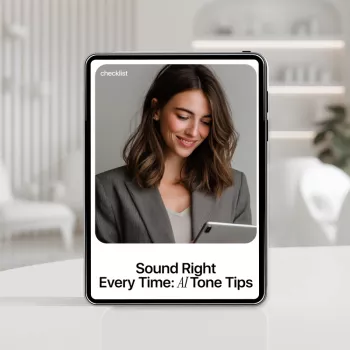
If you want a skimmable resource you can reuse during content batching and campaign launches, the Sound Right Every Time: AI Tone Tips – Digital Writing Guide, AI Content Checklist, eBook for Creators & Marketers is designed as a practical pre-flight system: set a tone target, fix “samey” phrasing, and run the channel checkpoints before publishing.
These same checkpoints also help keep messaging consistent across very different listings and categories—whether you’re updating a seasonal guide like Ready for Winter Ready for Anything – Winter Sport Gear Basics eBook, Complete Cold Weather Gear Guide, Layering & Equipment Checklist for Winter Sports or tightening product copy for items like Ichi Women’s Grey Cotton Stretch Jeans. The goal stays the same: clear promises, consistent voice, and a tone that fits the moment.
FAQ
How can AI writing sound less generic without adding fluff?
Add specifics (who it’s for, constraints, steps, examples), reduce repeated hedging, and replace hype with measurable claims. A final read-aloud pass catches robotic phrasing and sudden tone shifts quickly.
What’s the fastest way to match tone to different platforms?
Write one tone-target sentence, then adjust sentence length, formality, and CTA style to match the channel. Keeping a small library of approved examples for each platform makes “matching” almost automatic.
How do creators keep a consistent voice when using AI across many posts?
Maintain a tone library, a do/don’t list, and a two-pass review (meaning first, tone second). Reusing a short reference sample at the start of each draft helps prevent drift across a full batch of posts.
Recommended for you


Car Phone Mount Guide: Safer, Steadier Driving Setup
May 20, 2026












Leave a comment