-
Shop
- Advanced Technologies
- AI Career Advantage Collection
- AI Skills Mastery 2026 Collection
- Arts, Crafts & Hobbies
- Bathroom
- Best-Sellers
- Car Accessories
- Dating & Social Skills
- Denim
- 7FOR
- AGOLDE
- Antony Morato
- Armani Exchange
- Boss
- Brunello Cucinelli
- Calvin Klein Jeans
- Costume National
- Desigual
- Diesel
- Dolce & Gabbana
- Dsquared²
- Ermanno Scervino
- Fendi
- Gianni Lupo
- Guess Jeans
- Ichi
- Just Cavalli
- Lee
- Levi's
- Liu Jo
- Morgan De Toi
- Mother Denim
- Only
- Pepe Jeans
- Pinko
- Replay
- Valentino
- Vero Moda
- Digital Resources
- Education & Learning
- Family & Parenting
- Fashion
- Furniture
- Gadgets
- Health & Beauty
- Health & Wellness
- Home & Garden
- Kids & Babies
- Kitchen
- Lighting
- Patio, Lawn & Garden
- Personal Growth
- Pet Care
- Pet Supplies
- Pets
- Sport & Outdoors
- TikTok Growth & Monetization Mastery
- Travel
- Wealth
- Popular
- Best deals
Beginner AI Learning Plan: Build Skills Fast in 14 Days
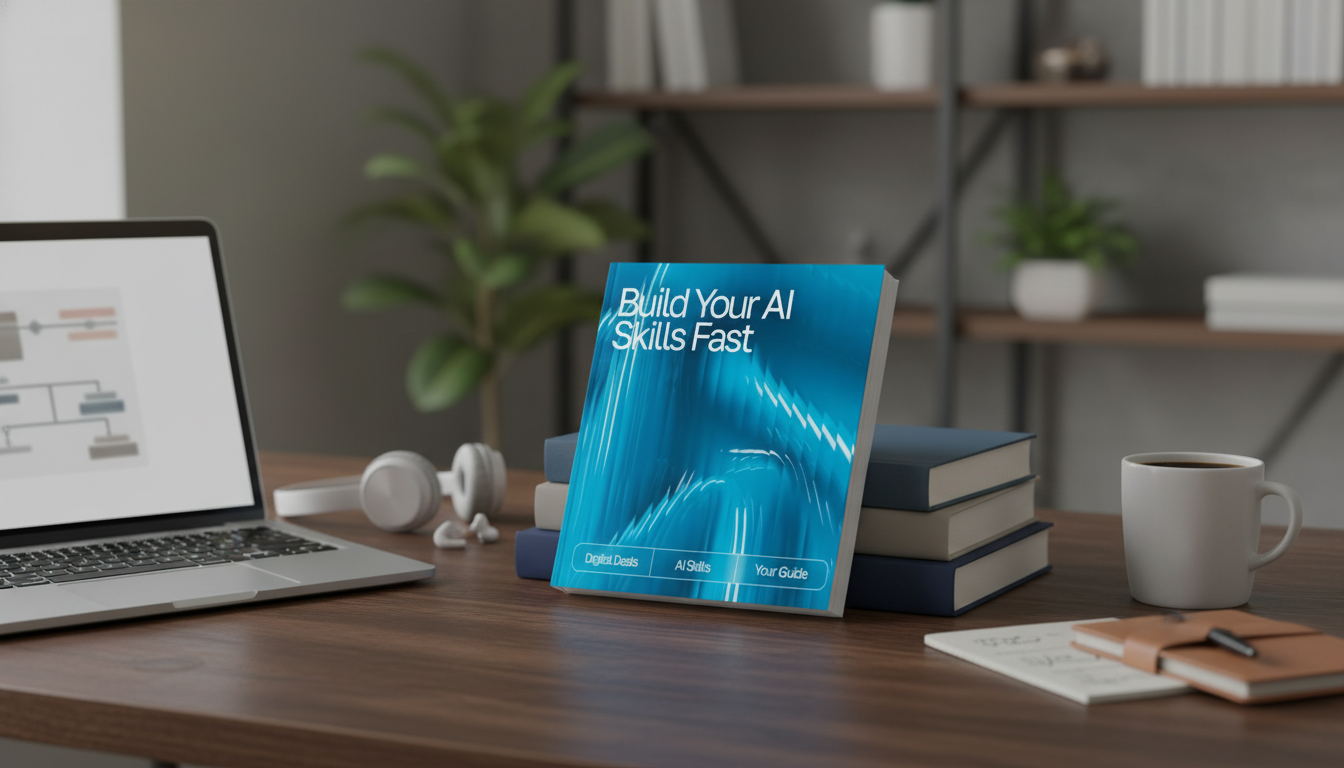
Build Your AI Skills Fast: A Simple Beginner Learning Plan That Actually Sticks
A fast start in AI comes from a clear plan: one goal, a small set of core concepts, and consistent practice. The fastest learners aren’t the ones who collect the most resources—they’re the ones who practice the same small workflow until it becomes reliable. Below is a beginner-friendly plan designed for busy schedules, built around real tasks, quick feedback, and habits that make your progress “stick.”
Start With One Outcome (Not “Learn AI”)
“Learn AI” is too big to execute. A single outcome is small enough to finish—and finishing is what builds confidence and momentum.
- Choose one outcome for the next 2–4 weeks: automate a spreadsheet task, build a small chatbot, analyze a dataset, or summarize documents reliably.
- Define a simple success check: “It works on three real examples without breaking.”
- Pick one primary tool track to reduce context switching: no-code AI tools, Python + notebooks, or prompt-based workflows.
- Timebox the plan: 20 minutes/day is enough if it is focused and repeated.
If you’re unsure which outcome to pick, choose the one that saves time this month. “Useful” beats “impressive” when you’re starting out.
The Beginner Core: What to Learn First
Early AI progress comes from learning a few fundamentals and applying them immediately. This isn’t a deep theory path—it’s a practical foundation that supports real work.
- AI basics: what models are, what training means, what inference is, and why data quality matters.
- Generative AI fundamentals: instructions, constraints, examples, and iteration; how to evaluate outputs for accuracy and usefulness.
- Practical foundations: working with text, tables, and simple analytics; basic probability intuition (optional but helpful).
- Safety and reliability habits: privacy, sensitive data handling, and how to verify answers before using them.
For a grounded view of responsible AI use and risk thinking, it helps to skim a real framework once, then turn it into simple habits. Strong starting points include the NIST AI Risk Management Framework and the OECD AI Principles.
Beginner topics mapped to quick wins
| Topic | Goal | Beginner exercise | Proof it worked |
|---|---|---|---|
| Prompting essentials | Get consistent outputs | Rewrite a prompt using role + constraints + examples | Same task succeeds 3 times in a row |
| Data basics | Reduce errors | Clean a small CSV (missing values, duplicates) | Fewer failed rows; clearer results |
| Model limits | Avoid false confidence | List 5 failure modes (hallucination, bias, stale info) | Added a verification step to workflow |
| Evaluation | Measure improvement | Create a 10-item test set for your task | Accuracy/quality improves across iterations |
A Simple 14-Day Plan (Rapid Skill Growth Without Burnout)
This two-week sprint is built to create something reusable. The goal isn’t perfection—it’s a dependable “version 1” you can improve.
- Days 1–2: pick the outcome, collect 5–10 real examples, and define a “done” checklist.
- Days 3–5: learn the basics and create a first working draft; keep a change log (what changed and why).
- Days 6–8: add structure—templates, checklists, or a simple pipeline (draft → verify → finalize).
- Days 9–11: introduce evaluation with a small test set; track failures and refine.
- Days 12–14: package the work into something reusable: a one-page SOP, a notebook, a reusable template pack, or a mini app/no-code automation.
One useful mindset: treat your workflow like a product. If it fails, the answer usually isn’t “try harder,” it’s “tighten inputs” or “add a check.”
The Weekly Routine That Keeps Momentum
Motivation comes and goes; a routine carries you through. Keep each session small enough that you can do it on low-energy days.
- Three modes of practice: Learn (10–15 min), Build (15–30 min), Review (10 min).
- Use a “smallest next step” rule: always end a session by writing the next action in one sentence.
- Batch learning: one new concept per day, then apply it immediately to your task.
- Keep a mistake library: save examples of bad outputs and the fix that improved them.
For extra context on how quickly AI tools and usage are changing, the Stanford HAI AI Index Report is a useful high-level scan. You don’t need to read it cover-to-cover—just enough to stay realistic about what today’s systems do well and where they struggle.
Common Beginner Roadblocks (and Quick Fixes)
A Compact Guide for Structuring the Plan End-to-End
If a step-by-step format helps you follow through, start here: Build Your AI Skills Fast | Beginner-Friendly eBook for Creating Your Simple AI Learning Plan.
- Ready for Winter Ready for Anything – Winter Sport Gear Basics eBook, Complete Cold Weather Gear Guide, Layering & Equipment Checklist for Winter Sports
- Cozy Cuddly Cowboy Bear Plush Toy – Soft Hugging Companion
FAQ
How long does it take to build useful AI skills as a beginner?
Many beginners can reach a first practical outcome in 2–4 weeks by focusing on one project and practicing consistently. Stronger fluency usually takes 8–12 weeks, especially if you add evaluation habits and build a reusable workflow with measurable checkpoints.
Do you need to learn coding to learn AI?
No—many useful AI workflows can be learned with no-code tools or structured text-based workflows. Coding becomes valuable when you want deeper customization, automation, or integration, and it can be added later once your outcome is clear.
What should a simple AI learning plan include?
Include one outcome, a weekly schedule you can actually keep, hands-on practice exercises, an evaluation method (even a small test set), a small project deliverable, and a quick review loop to capture mistakes and improvements.
Recommended for you



At-Home Baby Play: Sensory & Motor Ideas by Age
May 24, 2026












Leave a comment