-
Shop
- Advanced Technologies
- AI Career Advantage Collection
- AI Skills Mastery 2026 Collection
- Arts, Crafts & Hobbies
- Bathroom
- Best-Sellers
- Car Accessories
- Dating & Social Skills
- Denim
- 7FOR
- AGOLDE
- Antony Morato
- Armani Exchange
- Boss
- Brunello Cucinelli
- Calvin Klein Jeans
- Costume National
- Desigual
- Diesel
- Dolce & Gabbana
- Dsquared²
- Ermanno Scervino
- Fendi
- Gianni Lupo
- Guess Jeans
- Ichi
- Just Cavalli
- Lee
- Levi's
- Liu Jo
- Morgan De Toi
- Mother Denim
- Only
- Pepe Jeans
- Pinko
- Replay
- Valentino
- Vero Moda
- Digital Resources
- Education & Learning
- Family & Parenting
- Fashion
- Furniture
- Gadgets
- Health & Beauty
- Health & Wellness
- Home & Garden
- Kids & Babies
- Kitchen
- Lighting
- Patio, Lawn & Garden
- Personal Growth
- Pet Care
- Pet Supplies
- Pets
- Sport & Outdoors
- TikTok Growth & Monetization Mastery
- Travel
- Wealth
- Popular
- Best deals
Quiet Confidence Skills for AI-Driven Tech Teams

Quiet Confidence for Future-Ready AI Work
AI is changing how technical work is scoped, evaluated, and communicated—often faster than roles and titles can keep up. Quiet confidence helps tech professionals stay grounded, speak with clarity, and make good decisions under uncertainty without needing to perform certainty. The result is steady credibility: the kind that shows up in design docs, incident calls, stakeholder meetings, and review threads—especially when outcomes are probabilistic and timelines are compressed.
What Quiet Confidence Looks Like in AI-Driven Teams
Quiet confidence isn’t a personality type. It’s a set of repeatable behaviors that make you easier to trust when the work is messy and the signal-to-noise ratio is low.
- Calm competence: demonstrating progress and judgment without overselling or shrinking.
- Clear thinking under ambiguity: making assumptions explicit, testing quickly, and updating decisively.
- Boundaries and self-trust: knowing when to say “not yet,” “needs validation,” or “that’s out of scope.”
- Credible communication: explaining tradeoffs, limitations, and risks in plain language.
- Consistency over intensity: building reliability through repeatable habits, not bursts of hustle.
This style stands out in AI work because the most persuasive thing you can do is often to be precise about what you know, what you don’t, and what you’re doing next.
Why Confidence Becomes a Core Skill in the Age of AI
In AI-adjacent teams, confidence becomes operational. It influences planning, quality, and safety—not just career growth.
- Work cycles shorten: prototypes, model iterations, and stakeholder feedback loops compress timelines.
- Evaluation gets noisier: metrics can mislead, demos can over-impress, and uncertainty is normal.
- Roles blend: AI products require cross-functional fluency (data, UX, compliance, security, business).
- Visibility shifts: impact is often communicated through docs, reviews, demos, and decision logs.
- Risk is higher: mistakes can scale, bias can harm, and governance is increasingly scrutinized.
Broader labor and governance trends point in the same direction: adaptable skills and responsible AI practices are becoming foundational (see the World Economic Forum’s Future of Jobs Report and the NIST AI Risk Management Framework).
Common AI-Work Pressure Points and a Quiet-Confidence Response
| Pressure point | What it triggers | Quiet-confidence move | Example phrase |
|---|---|---|---|
| Ambiguous requirements | Overthinking or overpromising | State assumptions + propose a test | “Assuming X, the fastest check is Y; results by Friday.” |
| Model performance volatility | Self-doubt | Separate effort from outcome + inspect data | “Let’s verify the dataset shift before changing the approach.” |
| Stakeholder hype | People-pleasing | Ground claims in evidence and limits | “The demo works, but we need evaluation on edge cases.” |
| Public criticism or review comments | Defensiveness | Ask for specifics + respond with actions | “Which criterion failed? I’ll address that and report back.” |
| Rapid tool changes | Impostor feelings | Focus on fundamentals + learning cadence | “Tooling changes; the workflow is: define, test, measure, document.” |
The Confidence Skill Stack for Tech and AI Careers
Confidence at work is less about “feeling fearless” and more about having a system you can rely on. In AI-heavy environments, a practical stack looks like this:
- Self-efficacy: building proof through small wins, practice reps, and measurable progress.
- Cognitive clarity: reducing mental noise using checklists, constraints, and decision criteria.
- Emotional regulation: staying effective during incidents, deadlines, and high-stakes reviews.
- Professional presence: communicating without apology, filler, or unnecessary escalation.
- Ethical courage: speaking up about data issues, privacy, bias, security, and misuse risks.
Ethical courage matters more as AI touches regulated areas and vulnerable users. The OECD’s work on AI in society underscores why transparency, accountability, and risk awareness belong in day-to-day delivery—not just policy docs.
Daily Practices That Build Quiet Confidence (Without Performing Certainty)
Speaking With Authority About AI: Clarity, Limits, and Tradeoffs
Handling Impostor Feelings When Tools and Titles Keep Changing
Using “Quietly Confident in the Age of AI” as a Practical Work Guide
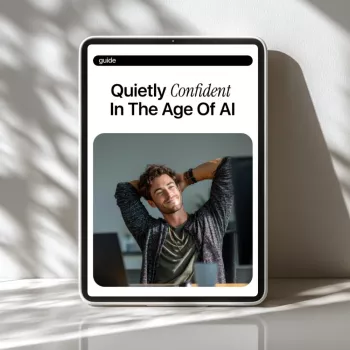
- Quietly Confident in the Age of AI – Practical Guide to Confidence Skills in AI Careers, Tech Professionals & Future-Ready Work (digital guide): use it to work through one skill per week—presence, communication, decision-making, feedback, and resilience—then apply the exercises to real deliverables like PRDs, evaluation plans, and postmortems.
- Body Confidence Blueprint | Ebook Guide on How to Build Body Confidence, Self-Image & Everyday Confidence (digital guide): useful when “work confidence” is being amplified by stress, self-image, or persistent self-criticism, and you want practical routines that improve everyday steadiness.
When Confidence Needs Extra Support: Feedback, Mentorship, and Health
FAQ
How is quiet confidence different from being extroverted or outspoken at work?
Quiet confidence is about clarity, reliability, and grounded communication—not being loud. It shows up as evidence-based decisions, clean boundaries, and consistent delivery regardless of personality style.
What can be done when AI uncertainty makes it hard to sound confident in meetings?
State assumptions, share what is known, name risks/unknowns, then propose the next test with a timeline. Phrases like “Given X, I recommend Y; we’ll validate with Z by Thursday” sound confident without overpromising.
Which roles benefit most from confidence skills in AI careers?
Nearly every role across the AI lifecycle benefits: software engineers, ML/data scientists, analysts, product managers, designers, QA, security, compliance, and leaders. Confidence skills help these roles align cross-functionally and make safer, more ethical decisions under uncertainty.














Leave a comment